The Photograph Problem: Why Customer Feedback Distorts What Happened
Customers remember peaks, endings and fragments. Learn why retrospective customer feedback distorts product experience and how in-context questions help.

People are poor at remembering experiences. Or rather, they are poor at remembering all of one.
That matters for customer feedback. When a SaaS team asks users to describe onboarding, a feature launch or a confusing product moment after the fact, the answer is shaped by memory bias: peaks, endings and a few vivid fragments. Retrospective feedback rarely captures the full product experience. It captures the version the customer can reconstruct later. In-context questions work better because the page, action or artifact is still present.
Consider the familiar exercise of emailing a new user a survey about their onboarding experience a week after they signed up. They cannot recall the individual steps with any precision. They retain a vague sense that the process was "a bit confusing," but not which of its ten stages caused the confusion. A survey sent after the fact does not measure what happened. It measures a reconstruction of it, and reconstructions are unreliable witnesses.
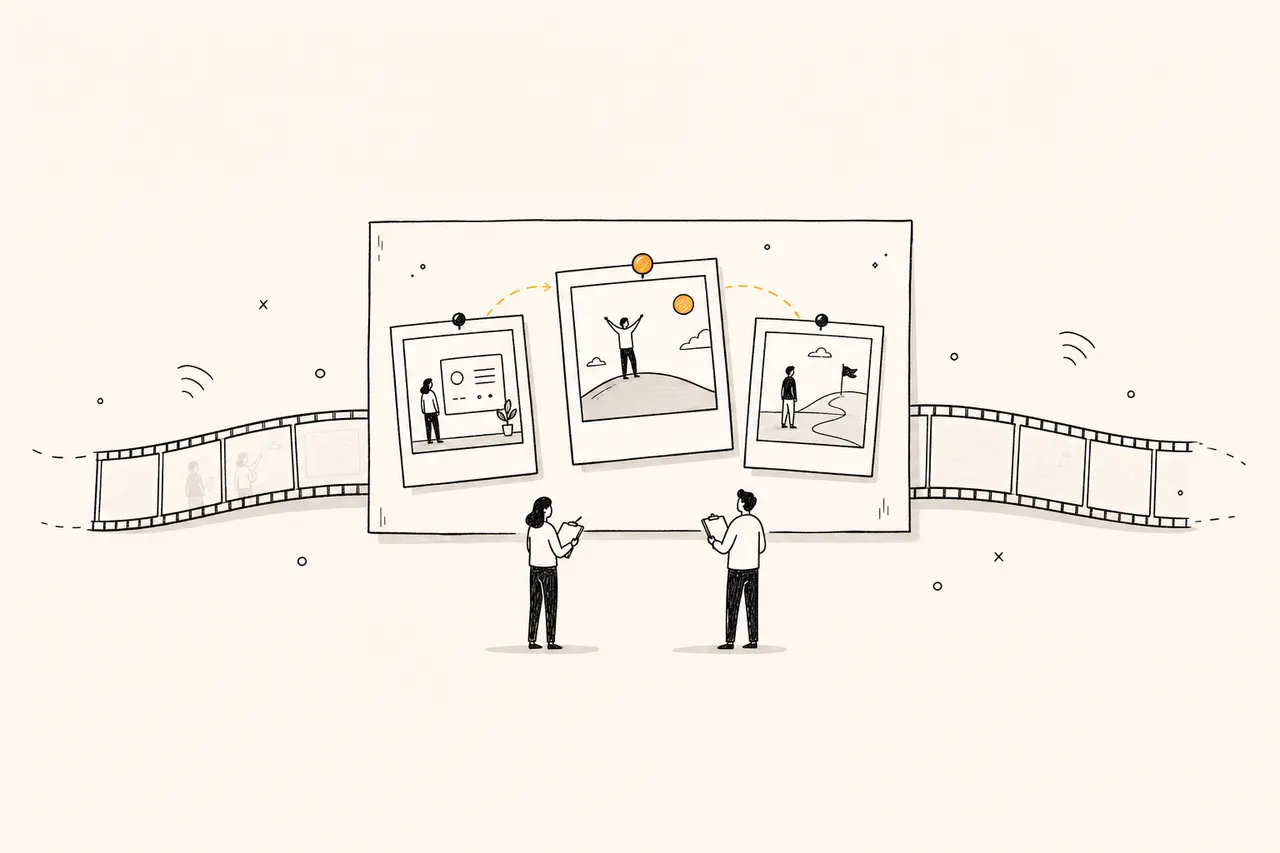
The reason is well documented. In their 1993 paper, Duration Neglect in Retrospective Evaluations of Affective Episodes, Barbara Fredrickson and Daniel Kahneman asked whether memory more closely resembles a film or a series of photographs.1 Their evidence pointed firmly to photographs: people evaluate an experience by averaging a few salient moments rather than by summing how they felt throughout.
Or, in the line from Milan Kundera that the authors borrow: memory does not make films; it makes photographs.
The peak and the end are the photographs that survive
If memory retains only a few frames, the question is which ones. The answer, replicated many times over, is the peak, the most intense moment, whether pleasant or painful, and the end. The rest is largely discarded.
The most striking evidence comes from medicine. In a 1996 study of colonoscopy and lithotripsy patients, Donald Redelmeier and Kahneman found that later recollection was not predicted by how long the procedure lasted or by the total discomfort endured.2 It was more closely tied to two moments: the worst, and the last. Counterintuitively, a longer procedure that tapered to a gentler conclusion could be remembered more favorably than a shorter one that ended at a sharper peak, despite containing, by any objective measure, more discomfort overall.
The same was found in a cold water experiment.3 Subjects immersed one hand in painfully cold water for sixty seconds, then the other for ninety: the same first sixty seconds, followed by thirty more during which the water was warmed slightly, remaining unpleasant but a little less so. Asked which trial they would prefer to repeat, most chose the longer one. They opted, in effect, for more total discomfort because the end was less uncomfortable.
The implication is worth dwelling on: additional unpleasant experience improved the memory of the event. Recollection does not perform arithmetic. It performs photography.
Duration scarcely registers
The corollary is what the authors term duration neglect: the finding that how long an experience lasts has little bearing on how it is remembered.1 In the original experiments, film clips lasting three times as long as their counterparts barely shifted overall evaluations. Longer pleasant clips were sometimes remembered as marginally worse, on the principle that good things satiate.
For a software product, this is the quiet hazard. UX researchers have applied the same peak-end pattern to how people remember product experiences.4 The cumulative friction a user wades through, the superfluous clicks, the ambiguous label, the sluggish load, weighs far less on their remembered verdict than the location of the single worst moment and the quality of the ending. A customer may endure a dozen minor irritations and still retain a favourable impression if the payoff arrived at the close. Another may have an otherwise smooth experience spoiled in memory by one bad peak. The judgment collected later is not a faithful summary of what was actually delivered.
The culprit is memory, not timing
This points to a tempting but mistaken remedy: send the survey sooner. If the trouble were merely the week-long delay, then a prompt email the morning after signup ought to fix it.
The research suggests otherwise. The decisive variable in Fredrickson and Kahneman's work was not simply how long subjects waited, but whether they judged an experience from live sensation or from memory. Those evaluating from memory exhibited the same distortions, and the passage of time, if anything, made duration matter less rather than more. Once the respondent is no longer in the experience, asking earlier does not restore the lost detail. The respondent is still consulting a photograph.
The only dependable way around a memory problem is to avoid relying on memory: to capture the judgment while the experience is still under way, before it is compressed into a few snapshots. A similar approach could apply to feedback.
How this distorts feedback
Taken together, retrospective feedback fails in three predictable ways.
First, the specifics vanish. A customer who stalled at the third step of onboarding recalls only that setup was "annoying," if that. The very detail required to fix the problem has already faded.
Second, the signal skews. A single frustrating peak can color an otherwise unremarkable experience, while a strong finish conceals genuine problems in the middle. Teams consequently over-correct for the dramatic and overlook the chronic.
Third, and most insidiously, the routine goes unexamined. The unremarkable but essential parts of a product, the steps through which nearly every user passes, are precisely those memory discards. Feedback falls silent exactly where the bulk of customers actually spend their time.
A roadmap built on fiction
For a small SaaS, engineering time is a scarce resource, and misdirecting it is costly. Distorted feedback is a reliable way to misdirect it.
The exact figures are easy to overstate, but the warning is useful. The Standish Group's 2013 CHAOS Manifesto makes the feature-bloat point this way: 20% of features are used often, 30% sometimes or infrequently and 50% hardly ever or never.5 The older Standish figure is often repeated as 64%, though Mike Cohn's review of that number is a useful caveat: the original dataset was narrow, so it should be treated as a warning about feature bloat rather than a universal law.6
This is not usually because of negligence. It is more likely the result of acting on the loudest, most recent or most vividly recalled request, a peak or an ending, in place of evidence from the moment itself. Memory-based feedback is a form of fiction, and a product cannot be built on fiction. Every feature shipped on the strength of a distorted snapshot represents engineering effort that might have gone to something a customer genuinely wanted, while it still mattered to them.
Asking while the photograph is still being taken
Fredrickson and Kahneman did not merely diagnose the problem. They also showed why abstract, global questions like "How was the film?" or "How was your holiday?" capture the peak and the end and little else.
A practical translation for product feedback is to use concrete, time-linked cues. These are prompts tethered to specific moments of the actual experience, which allow a person to respond to that moment rather than summarise the whole from memory, like video recall of the moment in question.
In-context product feedback is the applied form of this idea. The cue performs the remembering on the customer's behalf, so the response reflects experience rather than reconstruction. In practice, it takes several forms:
- Asking in the moment, where the screen itself is the cue. "Was anything unclear on this page?" asked immediately outperforms "How was setup?" asked a week later, because there is nothing left to reconstruct.
- Referring to the specific action just completed. "You have just connected your calendar. How did that go?" anchors the question to a single real moment rather than a vague interval.
- Surfacing the artifact of the work. Presenting the project created or the report generated attaches the question to something visible rather than a fading impression.
- Naming the moment, where a delay is unavoidable. "Yesterday you set up your first integration. What nearly stopped you completing it?" reinstates the episode far more effectively than a generic prompt.
- Triggering on the event rather than the calendar. Posing the question at feature use, at onboarding completion or at a point of abandonment ensures it arrives while the experience is still live.
There is a measurable dividend beyond accuracy. In-product prompts can increase the response rate of an email survey and the answers returned are likely to be more specific because nothing needs to be reconstructed. The feedback is both more plentiful and reliable.
The conclusion
Back to the onboarding survey. The company that asked "How was onboarding?" a week later received what memory dispenses: a photograph, a peak, an ending and little in between. The company that asks "Was anything unclear on this step?" the moment it is completed reads the experience directly, as it happens.
The problem, then, is not really one of collecting feedback. It is one of timing and memory. Memory makes photographs; in-context questions allow a company to watch the film.
Correct when and where the question is asked, and the answers begin to tell the truth: the most valuable actionable feedback.
This is the principle on which Signaldeck is built: lightweight questions asked at the moment that matters, kept tied to the page and the action, so that feedback remains useful after the first response arrives. If you want to start with one focused feedback loop, you can try Signaldeck for website and product feedback.
Notes and references
-
Fredrickson, B. L. & Kahneman, D. (1993). Duration Neglect in Retrospective Evaluations of Affective Episodes. Journal of Personality and Social Psychology, 65(1), 45-55. ↩ ↩2
-
Redelmeier, D. A. & Kahneman, D. (1996). Patients' memories of painful medical treatments: real-time and retrospective evaluations of two minimally invasive procedures. Pain, 66(1), 3-8. ↩
-
Kahneman, D., Fredrickson, B. L., Schreiber, C. A. & Redelmeier, D. A. (1993). When More Pain Is Preferred to Less: Adding a Better End. Psychological Science, 4(6), 401-405. ↩
-
Nielsen Norman Group. (2018). The Peak-End Rule: How Impressions Become Memories. ↩
-
The Standish Group. (2013). CHAOS Manifesto 2013. ↩
-
Cohn, M. (2015). Are 64% of Features Really Rarely or Never Used?. ↩